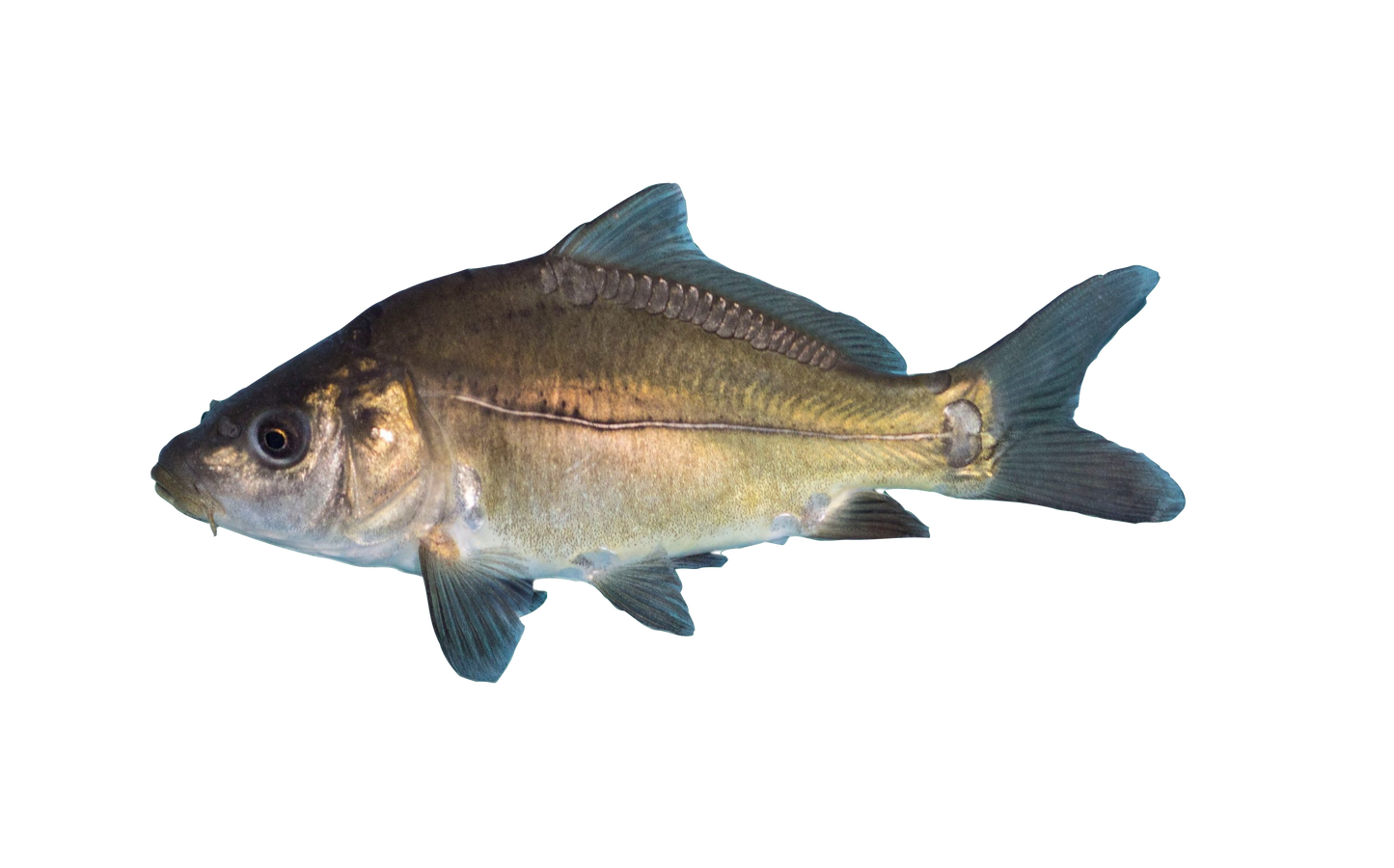

Mirror carp 10 - 14cm
Couldn't load pickup availability
Description
Description
Please note that we do not ship fish by mail. All fish must be collected from us in Oberweningen. We will professionally pack the fish for you and ensure sufficient oxygenation. This means that even longer transports can be handled without problems. Our staff will also be happy to advise you on transport and the correct introduction of the fish into your pond.
Origin and Appearance
The carp is probably one of the best-known European fish species. The wild form originally came from Asia and was brought to Europe by the Romans. Today, they are widespread throughout Europe, with the exception of Scandinavia. Due to their easy keeping and relatively fast growth, they were already a popular food fish back then.
Carp prefer warm, still, or slow-flowing waters with dense vegetation and soft bottoms. They can be found in all types of water, including ponds, gravel pits, rivers, large natural lakes, and even brackish water.
The original wild form is now hardly widespread. Carp breeding and the forms that have emerged from it are now the dominant carp forms due to stocking measures. Depending on the scaling of the carp, different subspecies are distinguished among the cultivated forms: common carp (fully scaled); linear carp (few but large scales along the lateral line); mirror carp (few but large scales on the back); leather carp (scaleless).
Care and Feeding
Carp are robust and adaptable fish that rarely get sick. Their peaceful and sociable nature allows for problem-free cohabitation with other carp-like pond fish. Carp are schooling fish and should not be kept alone. For smaller animals, we recommend a group of 5 or more; larger fish can also be kept in groups of 3 or more.
Carp are typical omnivores. However, they mainly feed on microorganisms, but also on insect larvae or worms, and rarely on plant-based food. In garden ponds, we feed carp with sinking pellets, as they primarily take their food from the bottom.
Carp reach sexual maturity at 3 - 5 years of age. The spawning season for carp takes place depending on the region from April - June, at a water temperature of 20 degrees or higher. During this time, the male develops what is known as the spawning rash, which appears as white spots on the gill cover or on the pectoral fins. For spawning, carp move into the shallow regions of their waters. There, the males begin to chase the females. The male nudges the female's flanks with its mouth, thus stimulating egg laying. Afterwards, the spawn is fertilized by the male. A female carp can lay up to 1,500,000 eggs, depending on its weight.
Good water values are a prerequisite for keeping carp, and a filter system and oxygenation are therefore essential for the well-being of the animals.
Water Temperatures and Wintering
Carp are native cold-water fish and can cope with a wide variety of conditions. They tolerate temperatures between 4 - 28 °C well. Wintering in our domestic garden ponds is therefore not a problem.
| Family | Cyprinidae |
|---|---|
| Scientific Name | Cyprinus carpio |
| Occurrence | Originally from Asia, now almost throughout Europe |
| Size | 40 - 120 cm |
| Water Temperature | 4 - 28° C, outdoor wintering possible with sufficient pond depth |
| Temperament | Peaceful and sociable |
| Diet | Omnivore, microorganisms, plants, sinking pellets |