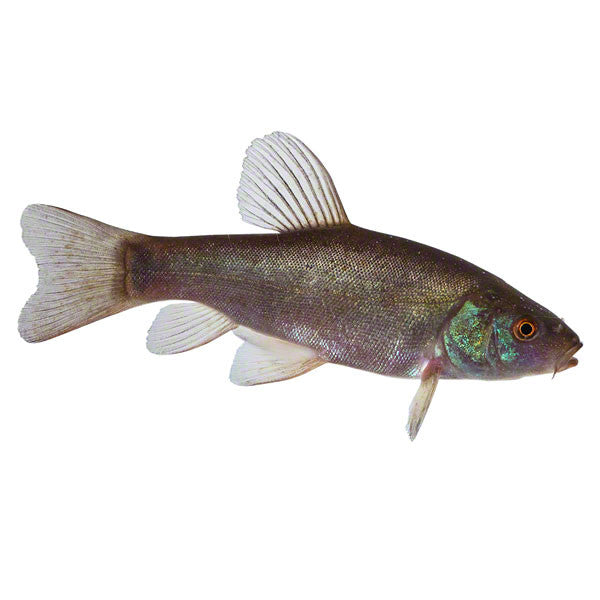

Tench 20-25cm
Couldn't load pickup availability
Description
Description
Please note that we do not ship fish by post. All fish must be collected from us in Oberweningen. We will professionally pack the fish for you and ensure sufficient oxygenation. This allows even longer transports to be handled without problems. Our staff will also be happy to provide you with information regarding transport and the correct introduction of the fish into your pond.
Origin and Appearance
The tench, also called Schlei or Schuster, is a native fish and belongs to the carp family. With a few exceptions, they are found throughout Europe and prefer slow-flowing or still waters. There they prefer to stay near reed beds, water lily fields, or heavily overgrown areas, where they primarily search for food on the bottom.
Tench are olive-green, their belly is yellowish to white. Their thick skin is slimy and covered with small scales. The mucous membrane has an antibacterial and antifungal effect. The terminal mouth is thick-lipped, protrusible, and, like the carp, has two barbels. Another typical feature is their strikingly large dorsal fin. Tench grow 20 - 70 cm long, can weigh up to 7 kg, and live for 35 years.
They are also considered excellent edible fish and are tastier than the more well-known carp. Their flesh is firm, low in bones and fat.
Keeping and Feeding
Tench primarily feed on microorganisms, snails, and plants. In domestic garden ponds, we feed tench with sinking pellets, as the fish prefer to take their food from the bottom. The light-shy tench are rather cautious when searching for and taking food and prefer the night or the early morning hours. The tench has no teeth in its jaw, but, like the carp, it has so-called pharyngeal teeth located deep in the back, with which it can crush the ingested food.
Tench are very robust and adaptable fish that can temporarily fall into a cold or heat stupor. Therefore, they can temporarily cope with very little oxygen. In smaller bodies of water such as village ponds or overgrown forest ponds, they are sometimes even the only fish species present thanks to this ability. Thanks to their peaceful nature, tench can be easily socialized with other carp-like pond fish.
The spawning season for tench takes place between April and June, depending on the water temperature. They require 18 - 20 degrees for successful reproduction. During this time, the females lay up to 300,000 eggs on aquatic plants, where they are then fertilized by the males. The female does not lay all the eggs at once; the spawning season can extend over 2 months. The sex of tench can be determined by their pectoral fins. Males have large, spoon-shaped fins, while females have longer and more pointed, rather triangular-looking fins.
Good water values are a prerequisite for keeping tench; a filter system and oxygenation are therefore essential for the well-being of the animals.
Water Temperatures and Wintering
Tench are native cold-water fish and can cope with a wide variety of conditions. They can tolerate temperatures between 4 - 28 °C well. Wintering in our domestic garden ponds is therefore not a problem.
| Family | Cyprinidae, Tincidae |
|---|---|
| Scientific Name | Tinca tinca |
| Occurrence | Throughout Europe with a few exceptions |
| Size | 20 - 70 cm |
| Water temperature | 4 - 28° C |
| Nature | Peaceful and sociable |
| Food | Plants, microorganisms, sinking pellets |