

Narrowleaf Cattail (Sold out)
Couldn't load pickup availability
Description
Description
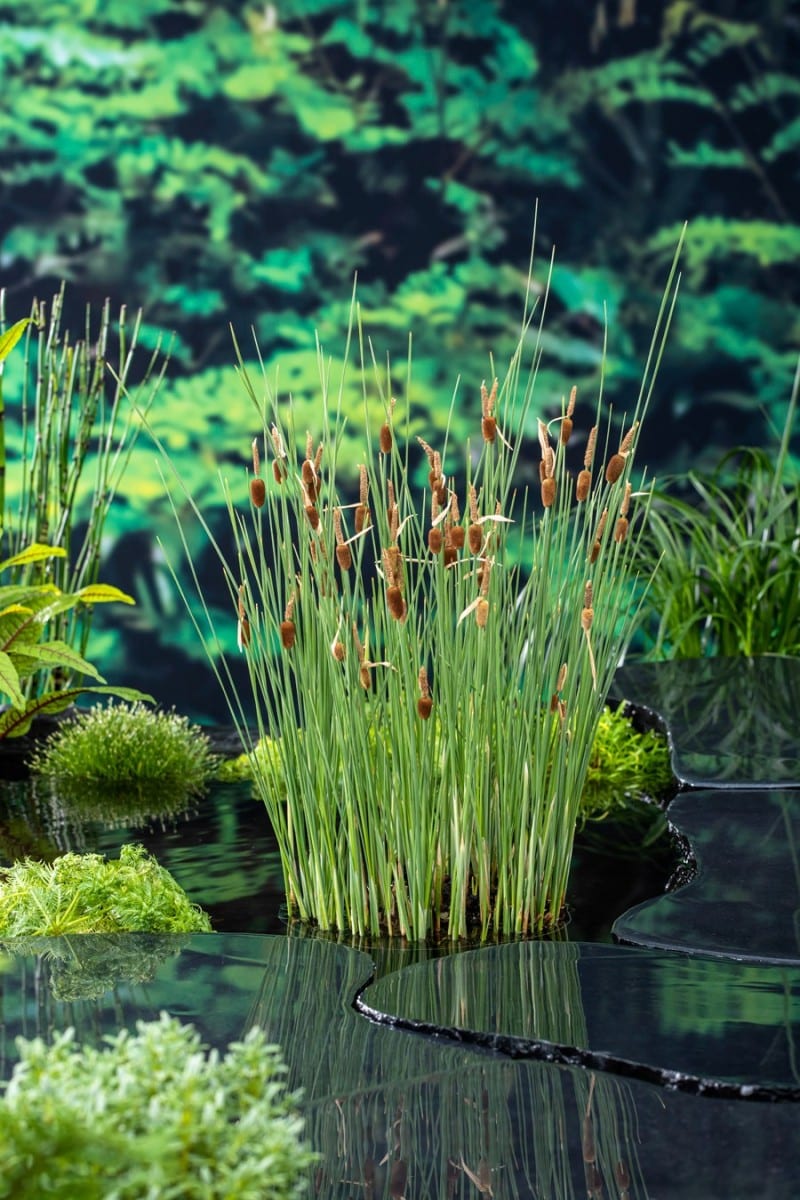
The Dwarf Cattail (Typha minima) is best showcased in a pond, but it can also thrive wonderfully in a suitably designed container. With its brown blooms, the Dwarf Cattail is an eye-catcher from June to July. Its linear leaves also contribute to its appeal. They are dark green. In autumn, the deciduous leaves turn orange.
This aquatic plant needs water depths of 5 cm to 10 cm to develop into a beautiful, upright, compact specimen of up to 50 cm in height and 35 cm in width, and the location should also be sunny.
Growth
An upright and compactly growing plant that can reach a good 40 cm to 50 cm in height and 30 cm to 35 cm in width.
Leaves
The linear leaves have a dark green color. Before leaf fall, they take on beautiful orange hues.
Flowers
The Dwarf Cattail's blooming period begins in June. It then bears brown catkins. The bloom lasts until July.
Frost hardiness
Temperatures around -19°C are still tolerated by the Dwarf Cattail, making it considered frost-hardy.
Location
As an aquatic plant, the Dwarf Cattail prefers a sunny spot in a pond with 5 cm to 10 cm of water depth.
Soil
This plant grows best in well-drained soil.
Care
The Dwarf Cattail requires little effort in terms of care, as it is described as an easy-care plant. However, it is recommended to observe the following:
- This plant should not be pruned in autumn, as it looks beautiful in winter, or the dead plant parts serve as winter protection. Prune only in spring before new growth appears.
Usage...
...for example, at the pond edge, along streams, in the pond, as landscape shrubbery, as a container plant, or as a cut flower.
Plant partners
Plant combinations always work particularly well. For the Dwarf Cattail's vicinity, suitable companions include Marsh Forget-Me-Not, Monkey Flower, and Water Mint.
Natural distribution
The home of the species Typha minima is found in Europe.
Tasks
Time to...
- Pruning: From March to February