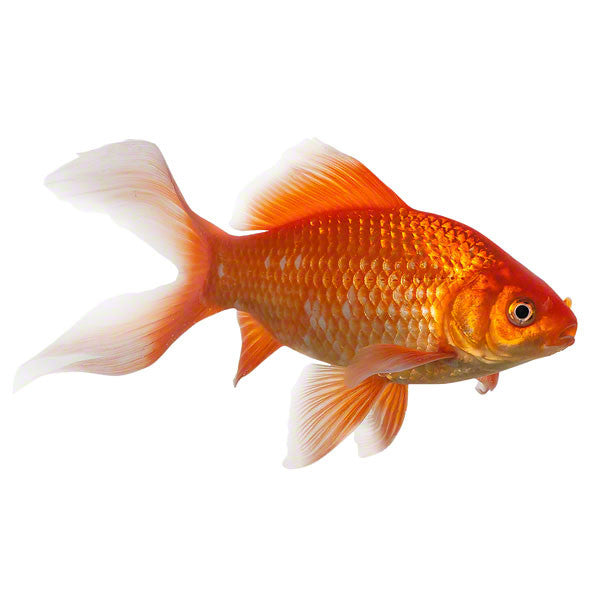

Goldfish 8-10 cm
Couldn't load pickup availability
Description
Description
Please note that we do not ship fish by mail. All fish must be picked up from us in Oberweningen. We will professionally pack the fish for you and ensure sufficient oxygenation. This allows even longer transports to be handled without problems. Our staff will also be happy to inform you about transport and the correct introduction of the fish into your pond.
Origin and Appearance
The goldfish is one of the oldest known domesticated animals. It belongs to the carp family and was first bred in China from the Prussian carp over 1000 years ago. Accordingly, the goldfish is a purely domesticated animal and did not originally exist in nature in the form we know it today. In Asia, they were already considered a symbol of luck and fertility.
Although they belong to the carp family, goldfish do not have barbels. They have no teeth in their jaw, but they do have pharyngeal teeth in their throat, with which the fish can, for example, crush pellets. Goldfish have no stomach; the actual digestion takes place in the intestine. They can live up to 30 years and grow up to 35 cm long. Goldfish are black at birth and only begin to change color from the 8th month of life.
Today we know a wide variety of cultivated forms of the common goldfish. The most well-known are the black, blue, red and white Shubunkin and the red and white Sarasa goldfish.
Care and Feeding
Although goldfish originally came from breeding, they were later able to establish themselves in the wild all over the world, as they are very robust and adaptable. Smaller groups can therefore even be kept in aquariums of 200 liters of water or more with appropriate filtration and aeration.
Goldfish prefer to live in schools, their social behavior is extremely pronounced, so we recommend keeping at least 3, preferably 5 or more, animals. Their good-natured and friendly nature allows for problem-free cohabitation with other pond fish. Goldfish are classic omnivores. Small animals, plants or pellets are on their menu. Special goldfish pellets have proven successful in garden ponds; ideally, the animals should be fed 1-2 times a day in small quantities.
The spawning season for goldfish is from spring to summer, and spawning takes place in the early morning hours. The female lays the eggs on plants or similar, where they are then fertilized by several males. During the spawning season, the male animals show the so-called breeding tubercles on their heads and gill covers; female fish are much plumper during this time.
Good water quality is a prerequisite for keeping goldfish; a filter system and oxygenation are therefore essential for the well-being of the animals.
Water Temperatures and Wintering
Goldfish are cold-water fish and can cope with a wide variety of conditions. They can tolerate temperatures between 4 - 28 °C well. Wintering in our domestic garden ponds is therefore not a problem.
| Family | Cyprinidae |
|---|---|
| Scientific Name | Carassius auratus |
| Occurrence | Asian cultivated form of the Eurasian Prussian carp |
| Size | up to 35 cm |
| Water Temperature | 4 - 28° C, outdoor wintering possible with sufficient pond depth |
| Temperament | Peaceful and social |
| Diet | Omnivore, pellets, insects and plants |