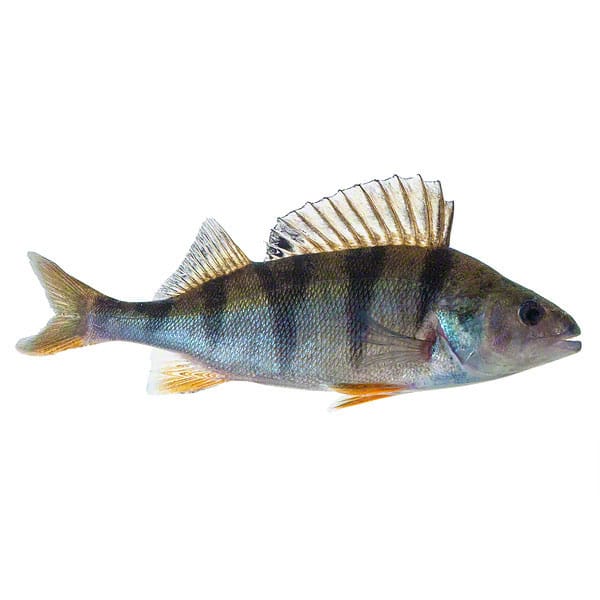

Perch (Egli) approx. 20cm
Couldn't load pickup availability
Description
Description
Please note that we do not ship fish by post. All fish must be collected from us in Oberweningen. We will pack the fish professionally for you and ensure sufficient oxygenation. This means that even longer transports can be managed without any problems. Our staff will also be happy to provide you with information regarding transport and the correct placement of the fish in your pond.
Origin and Appearance
The European perch, also simply called perch or Egli in Switzerland, can be found throughout Europe in a wide variety of waters. It is the most common perch species and has the widest distribution of its genus.
Typical features of the perch are its split dorsal fin, as well as the reddish coloration of the pelvic and pectoral fins. The perch has spiky spines on both its dorsal fins and its anal fin. The gill covers taper to a point at the back and have a thorn. The perch is gray-yellow-brown-greenish in color and has 6 - 8 vertical, black stripes. It has a large, slightly superior mouth with small sharp teeth, which indicates that it is predatory and feeds on small fish.
On average, perches grow 20 - 40 cm long and weigh 50 - 350 g, depending on the food supply in the respective region. However, there are exceptional specimens that can reach 60 cm and weigh up to 5 kg. Perches grow rather slowly; on average, at 8 years old, they are only 25 cm long. Under good conditions, they can live up to 20 years.
The larvae of the European perch first feed on plankton, later they become predators and feed on small fish (mainly cyprinids), and some are also cannibalistic.
The European perch is very adaptable, which is why it is found almost everywhere in Europe. Whether in large lakes, rivers, streams or sometimes even in brackish water. However, it avoids heavily silted areas or very shallow waters. Young perches stay in schools and rather in the bank zones of the waters, older specimens prefer deeper water areas and usually live as loners.
Care and Feeding
If you want to keep perches in your garden pond, there are a few things to consider. It is very important to stock fish from breeding. If you put animals from the lake or river into your pond, there is a great risk of introducing diseases. In addition, wild animals are less stable, and the chance of them surviving in captivity is rather low. Farmed animals are more robust, and they are also used to being fed with pellets. Wild animals do not accept pellets and would therefore starve in the garden pond.
When feeding Egli, it is important to choose a sinking food with a high fat content, preferably sturgeon food. It is important not to put too much food into the pond at once, as the Egli only eat the food during the sinking phase (predatory reflex). So, take your time when feeding and only put a few pellets into the pond at a time.
Perch are normally sexually mature at 2 years of age. The spawning season is between March and June. The female lays the eggs in the form of spawn strings on aquatic plants or branches, where they are fertilized by the males. The hatched larvae then first go to the water surface to fill their swim bladder. Young perches live in schools with several animals, older fish are usually loners and territorial.
Good water values are a prerequisite for keeping perches, a filter system and oxygenation are therefore essential for the well-being of the animals.
Water temperatures and overwintering
Perches are native cold-water fish and can cope with a wide variety of conditions. They can tolerate temperatures between 4 - 28 °C well. Overwintering in our domestic garden ponds is therefore not a problem.
Family True Perch
Scientific name Perca fluviatilis
Occurrence Widespread throughout Europe
Size On average 20 - 40 cm, individual specimens up to 60 cm are possible
Water temperature 4 - 28° C
Nature Predatory. As young animals in schools, older animals as loners
Food Live food, small fish and similar, in the pond also pellets