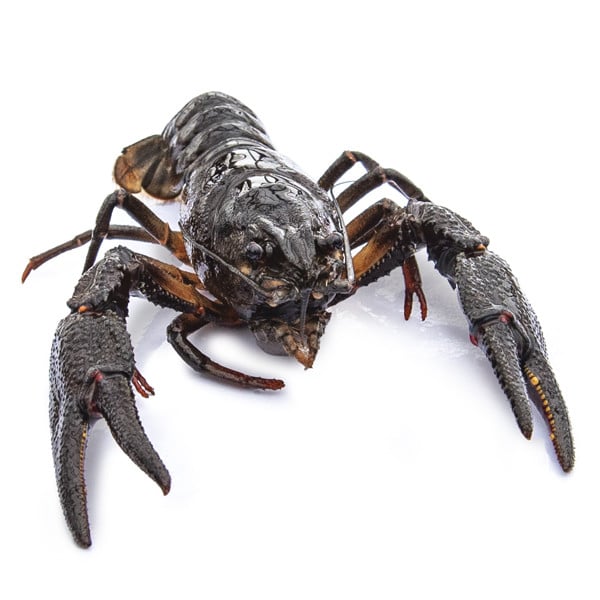


Noble crayfish
Couldn't load pickup availability
Description
Description
Please note that we do not ship crayfish by post. All crayfish must be collected from us in Oberweningen. We will pack the crayfish professionally for you and ensure sufficient oxygenation. This means that even longer transports can be managed without problems. Our staff will also be happy to inform you about transport and the correct placement of the crayfish in your pond.
Origin and Appearance
With a length of up to 20 cm, the noble crayfish is the largest native species of freshwater crayfish. Females remain somewhat smaller. The crayfish usually have a dark brown coloration, but blue and orange color variants also occur. However, these colors often disappear with the next molt.
Noble crayfish are very similar to the invasive American signal crayfish. Like them, noble crayfish also have two-part eye ridges and almost always a red underside of the claws. However, the noble crayfish can be reliably distinguished by its reddish joint membrane between the claw segments and by some clearly palpable lateral spines near the nuchal groove. In the past, noble crayfish were found in almost all larger bodies of water in Central Europe. But crayfish plague, a deadly animal disease, and strong competition from invasive American freshwater crayfish species have led to the disappearance of these animals in many waters. However, water pollution by pesticides from agriculture also contributes to this.
Keeping and Feeding
Keeping noble crayfish in your own garden is not difficult, as long as the following is observed: The depth of the pond should be at least 1m. Since crayfish have high demands on the water, the pond should not be exposed to contamination by herbicides or pesticides. Crayfish do not like it too cold; the water temperature should be between 16 and 24°C in summer.
The nature of the pond is also important. Due to its special behaviors, the crayfish needs diggable edges, stable bottom and edge conditions, and a generous bank area. Keeping them in foil ponds and tubs is possible, but not ideal, as the digging possibilities are rather limited here. Because the crayfish spends a lot of time digging: it even builds self-dug tubes, which it defends as its own dwelling. But there is another thing that is very important to the crayfish and contributes significantly to its living comfort: hiding places! Whether large stones, roots, ridge tiles or similar, the crayfish needs places to hide. Here it spends the day, hides when threatened, or eats its prey in peace.
When it comes to eating, the crayfish is not nearly as picky as it is with its pond requirements, because it is an omnivore. Dead fish, worms, snails and insects are on its menu, as are fallen leaves, plant remains and algae. In general, you don't have to worry about your own pond plants. The crayfish feeds not on living, but rather on dead plant parts; these are softer and therefore easier to consume. Since they already find everything necessary in the pond, it is generally not necessary to feed them extra.
The fact that the crayfish is not such a picky eater benefits your pond. Since they clean the water of organic residues, such as dead plants and dead animals, they ensure good water quality. It is not for nothing that crayfish are also called "the health police of the pond".
Family Crayfish
Scientific Name Astacus
Occurrence Central Europe
Size up to 20 cm (without claws)
Water temperature 16-24°C
Characteristics reddish underside of claws, two-part eye ridges, claw joint membrane is red
Food
Omnivore, dead fish, worms, insects, dead plant parts