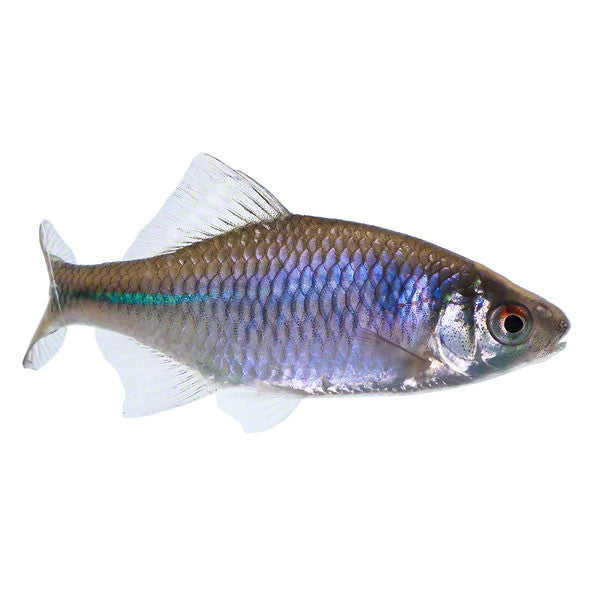

Bitterling approx. 3 - 4cm
Couldn't load pickup availability
Description
Description
Please note that we do not ship fish by mail. All fish must be picked up from us in Oberweningen. We will professionally pack the fish for you and ensure adequate oxygen enrichment. This allows even longer transports to be handled without problems. Our staff will also be happy to provide you with information regarding transport and the correct introduction of the fish into your pond.
Origin and Appearance
The bitterling is an indigenous small fish belonging to the carp family. They are high-backed and laterally flattened, with a small head. They have relatively large scales, and the dorsal and anal fins are quite long. The flanks and belly are silvery, and the back is grey-green. Bitterlings grow to 5 - 10 cm and weigh an average of 15 g.
Bitterlings are found in Central Europe and eastwards to the Caspian Sea. They prefer to live in slow-flowing or still waters that are rich in plants and have a muddy or sandy substrate if possible.
The fish gets its name, bitterling, from its bitter taste. In economically harder times, the bitterling was also on the menu, but today it is no longer of any importance as a food fish.
Care and Feeding
Bitterlings are peaceful schooling fish that thrive even in small bodies of water. Therefore, they are perfect as stocking fish for biotopes or smaller garden ponds. Their good-natured nature allows for problem-free cohabitation with other small schooling fish or good-natured cyprinids.
Bitterlings primarily feed on small invertebrates and algae; in a home garden pond, they readily accept special mini pellets. Bitterlings also eat mosquito larvae, thus helping to curb the annoying mosquito plague.
Bitterlings reach sexual maturity at 2 - 3 years of age. The spawning season for bitterlings is between April and June. During spawning season, the male's colours intensify to attract potential mates. The throat and chest turn reddish, and the posterior part of the body takes on an iridescent greenish hue. To reproduce, the bitterling employs a very special strategy: it lives in symbiosis with the large river or pond mussel. Mating-ready males choose a mussel, which they then vehemently defend against other males. The males then try to lure a female to their mussel with a "courtship dance". During this time, the female develops an approx. 5cm long ovipositor, with which she lays her eggs into the pond mussel. Shortly thereafter, the male releases sperm, which penetrates the mussel's gill chamber through its respiratory water, fertilizing the eggs laid there. The hatched larvae spend 2 - 4 weeks inside the mussel before leaving the hospitable host at about 5 - 8mm in size. Normally, a female bitterling lays a maximum of 2 eggs per mussel. A female can lay 40 - 100 eggs, which she distributes among different mussels and different partners. Due to this behaviour, several stages of larvae from different bitterling pairs can be present in one mussel. The mussel also benefits from this symbiosis: the mussel's larvae (glochidia) attach themselves to the young bitterlings and are thus dispersed again.
Good water quality is a prerequisite for keeping bitterlings, so a filtration system and oxygen enrichment are essential for the well-being of the animals.
Water Temperatures and Wintering
Bitterlings are indigenous cold-water fish and cope well with a wide variety of conditions. They can tolerate temperatures between 4 - 28 °C. Therefore, overwintering in our domestic garden ponds is not a problem.
| Family | Carp fish, Cyprinidae |
|---|---|
| Scientific Name | Rhodeus amarus |
| Occurrence | Central Europe and east to the Caspian Sea |
| Size | 9 - 10 cm |
| Water Temperature | 4 - 28° C |
| Temperament | Peaceful and sociable |
| Food | Plants, microorganisms, mini pellets |