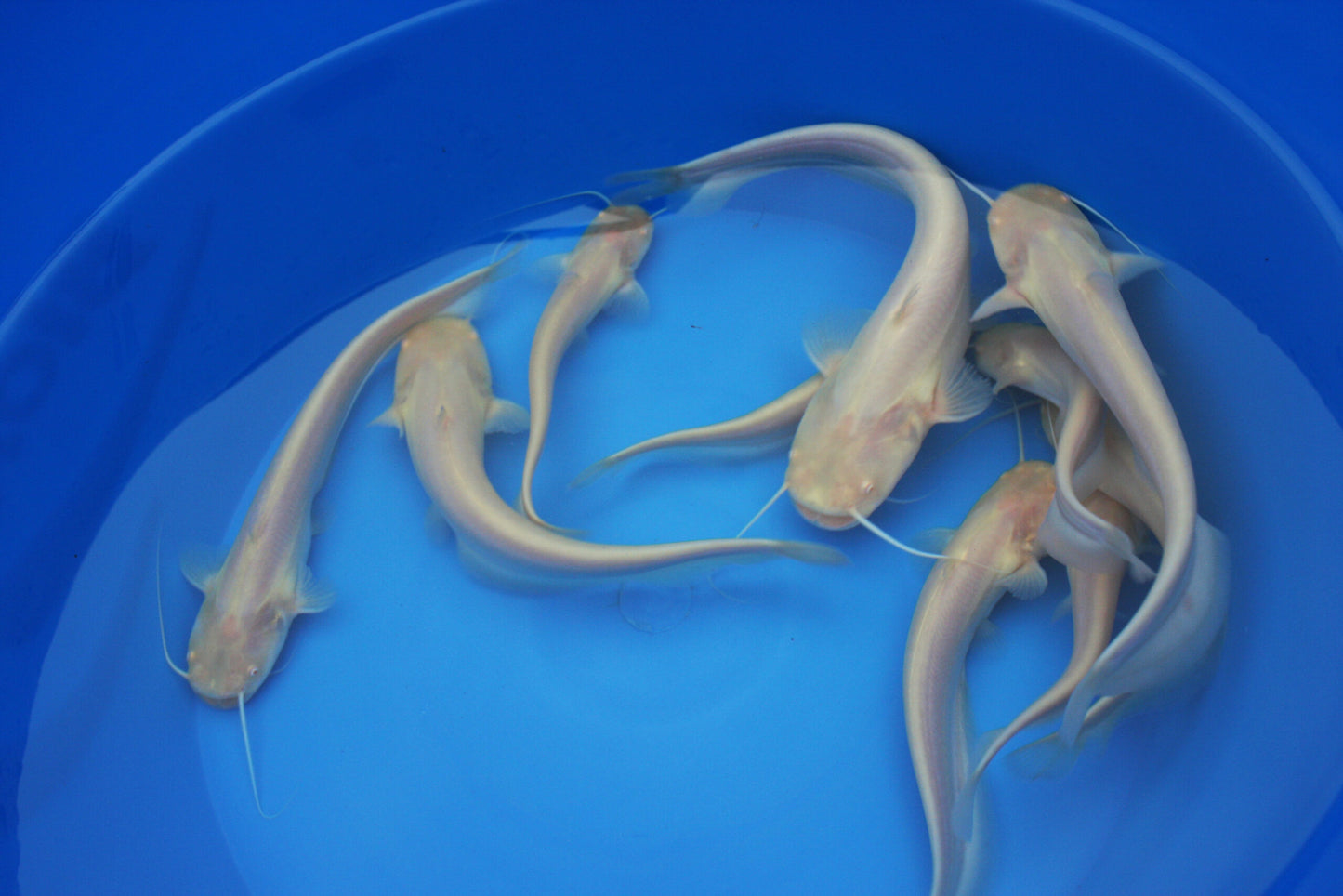

Albino catfish approx. 10cm
Couldn't load pickup availability
Description
Description
Please note that we do not ship fish by mail. All fish must be collected from us in Oberweningen. We will professionally package the fish for you and ensure adequate oxygen enrichment. This allows even longer transports to be handled without problems. Our staff will also be happy to inform you about transport and the correct placement of the fish in your pond.
Minimum Keeping Conditions:
European Catfish or Wels Catfish Silurus glanis /Albino Catfish Silurus glanis auratus
Adult size of fish: usually 1.5 to 2m, in some areas like Spain or Ukraine even over 5m
Minimum pond size*: 10,000 liters
Minimum water volume per adult fish*: Solitary when older, the larger the catfish, the more space it needs. Large catfish should be kept individually. When keeping multiple catfish, large catfish require a lot of space to avoid fighting each other.
Minimum pond depth for overwintering adult fish*: 1.20 m (large area, not just a small spot)
Optimal water temperature: 22-27 °C
Water temperature tolerated for a period: around 4 and 30 °C
Water parameters: pH 6-8, KH>4, NO+NH as low as possible,
Food: Predatory fish, as juveniles insects and worms, later also live fish and even frogs, ducklings etc... Catfish can swallow fish up to half their own length. Can be accustomed to artificial food, e.g. trout food or sturgeon food, in a garden pond or large aquariums; as juveniles, frozen food such as frozen midge larvae or beef heart from the pet store is also popular.
Original habitat: Europe, now in almost all waters except small streams and mountain rivers; in some areas, catfish are already becoming a nuisance.
Our fish come from: European fish farms
Sexual differences: only recognizable at an age of about half a meter; males usually grow a bit longer but remain slimmer.
Special considerations for keeping: as juveniles, they often swim in shoals, but can also be kept as solitary animals. Very well suited for regulating the juvenile fish population. Catfish become increasingly aggressive towards each other with age. Therefore, individual keeping is recommended. With good water quality/filtration, keeping larger groups is also possible, as aggression then disperses and the catfish form a hierarchy. Nevertheless, fights occur among catfish, where they bite each other's mouths and fins, which are often injured. Keeping small groups of a few animals is bad, as the weakest animal is often killed and often eaten as soon as it fits into the mouth of a larger catfish. Catfish grow very quickly; in warm water, they can reach over 40cm in length within the first year. Catfish are nocturnal and like to hide during the day. Therefore, one or two hiding places should be provided for each catfish.
Reproduction: In spring, the male builds a nest, usually a pit under a shelter. Several thousand eggs are laid there and guarded, often until the juvenile catfish are 6-10cm long. If food is scarce, the juvenile catfish eat each other.
Catfish prefer calm waters and can tolerate low oxygen levels. They are sensitive to high ammonium levels. They are also susceptible to bacterial infections. Catfish particularly often get the white spot disease Ichtyophthirius, and often common medications do not help and are not allowed for food fish. White spot disease is present in many waters; these parasites form cysts that survive for years in the mud and on the water surface, but many fish are immune to it, while catfish are very susceptible.